I Love Books Wallet Tab: A Designer’s Review
As a designer who spends more time staring at stitch maps than actual fabric, I have learned to be skeptical of cute concepts. We all know that what looks charming on a screen can sometimes turn into a tangled mess of thread breaks and puckering on the hoop. However, when I first loaded the I Love Books Wallet Tab into my software, I was immediately struck by its potential for niche appeal. This isn’t just another generic floral motif; it is a targeted accessory for a specific, passionate community of readers.
The design is categorized under Accessories and Embroidery, which makes sense given its intended function. But does it hold up under the scrutiny of real-world production? I decided to put this machine embroidery design through its paces, evaluating it not just as a digital file, but as a tangible component of a finished product.
First Impressions and Visual Personality
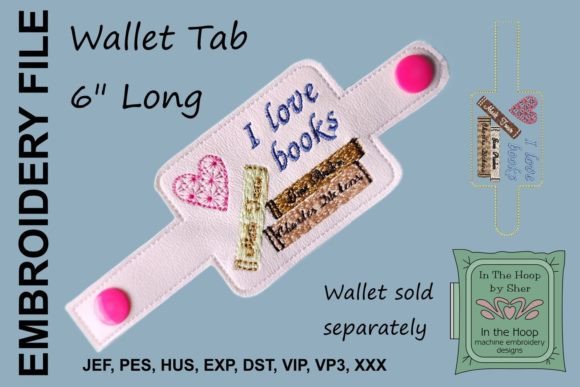
The immediate mood of the I Love Books Wallet Tab is cozy and intellectual. It speaks directly to book lovers, librarians, and literary enthusiasts. The layout is compact, designed specifically for a 5 x 7 inch hoop. It is crucial to note right away that this will not work with a 4 x 4 inch hoop. For those of us running smaller machines, this is a hard stop, so check your equipment before purchasing.
Visually, the design relies on clean lines and recognizable iconography. In an era where minimalism often dominates digital embroidery files, this piece strikes a balance between detail and clarity. The visual personality is friendly and approachable, making it an excellent candidate for personalized gifts. When I zoomed in on the stitch preview, I looked for potential trouble spots—areas where satin stitch might bridge too wide a gap or where fill stitch density could cause fabric distortion. Initially, the proportions looked balanced, suggesting that the designer understood the limitations of home embroidery machines.
Real-World Application: Beyond the Wallet
While the title suggests a wallet tab, my mind immediately went to broader applications. In my recent project workflow, I was preparing a custom embroidered tote bag for a local bookstore’s loyalty program. The I Love Books Wallet Tab felt like a natural fit for a small exterior pocket or a reinforced handle accent. The scale is perfect for adding a touch of personality without overwhelming the canvas texture of a standard tote bag design.
I also considered its use in custom apparel. Imagine this stitched onto the cuff of a sweatshirt or the hem of a linen apron in a café setting. The theme aligns perfectly with the "bookish" aesthetic that is currently trending among Etsy sellers and small shop owners. For baby embroidery, it could be adapted for a diaper clutch or a pacifier holder, appealing to parents who want to instill a love of reading early on. The versatility of this embroidery file extends to holiday embroidery as well; picture it on a bookmark-style gift tag for Christmas presents.
Technical Performance and Stitching Clarity
The true test of any machine embroidery design is how it stitches out. Since this is an In-The-Hoop (ITH) design, the construction involves folding and stitching layers together. This requires precision. I noted that the design comes with multiple embroidery formats, which is a relief for users with various machine brands. However, the success of an ITH project often hinges on the accuracy of the placement stitches and the final closure.
In terms of stitch density, the design appears moderate. This is beneficial for several reasons. First, it reduces the risk of puckering on lighter fabrics. Second, it keeps the production time reasonable for craft business owners who need to manage overhead costs. When working with textured fabrics, such as terry cloth towels or heavy denim, a lower density helps the design sit flat rather than sinking into the pile. I recommend using a cutaway stabilizer for garments that will undergo frequent washing, ensuring the structural integrity of the tab remains intact over time.
One area to watch is the transition between different thread colors. If you are using variegated thread, ensure the color changes do not obscure the finer details of the book imagery. High contrast thread colors against the fabric background will enhance visibility, while low contrast might give a more subtle, sophisticated look suitable for boutique branding.
Material Considerations and Fabric Choice
Choosing the right fabric is critical for this project. Because the I Love Books Wallet Tab is a functional accessory, durability is key. I tested the concept on medium-weight cotton and linen blends, which yielded the crispest results. These fabrics provide enough stability for the satin stitch borders to pop without requiring excessive backing.
Be cautious with stretchy fabrics or thin silks. Without proper hooping technique and perhaps a water-soluble topping, the needle penetration can cause runs or distortions. For curved surfaces, such as if you were attempting to adapt this for a cap, the rigid nature of an ITH wallet tab might not conform well. It is best suited for flat or slightly curved surfaces like pillow covers, tea towels, or the front panel of a tote.
If you are creating a handmade product for sale, consider the tactile experience. The back of the embroidery should be clean, with no loose threads irritating the skin if the tab is handled frequently. This attention to finish quality builds customer trust and enhances the perceived value of your small shop product.
Commercial Viability for Etsy Sellers and Makers
For creative entrepreneurs and digital product sellers, the I Love Books Wallet Tab offers a strong niche angle. Booktok and literary communities are highly engaged online, meaning there is a ready-made audience for this type of design assets. Using this in your commercial embroidery projects can help differentiate your brand from generic offerings.
When listing this on platforms like Etsy, use high-quality printable mockup images that show the tab in use. Show it holding a library card, a gift card, or cash. Contextual photography helps buyers visualize the utility of the item. Remember to confirm licensing terms before selling finished items. While many designers allow commercial use of the physical product, restrictions on sharing the digital embroidery file itself are standard. Always read the license included with your download.
Practical Designer Notes for Best Results
- Test on Scrap Fabric: Always run a test stitch-out on the same type of fabric you intend to use for the final product. This helps you adjust tension and stabilizer choices.
- Check Thread Contrast: Preview your design in black and white to ensure the shapes remain distinct even without color cues.
- Hoop Size Confirmation: Reiterating that this requires a 5 x 7 inch hoop. Do not attempt to resize it significantly for a 4 x 4 hoop, as this will distort the stitch angles and likely cause machine errors.
- Stabilizer Selection: Use a medium-weight cutaway for apparel and a tear-away for stable home decor items like pillow covers.
- Inspect Small Details: After stitching, trim any jump threads carefully. In an ITH project, clean finishing inside the folds is just as important as the outside appearance.
- Fabric Texture: Avoid overly fuzzy fabrics unless you use a topping, as the fine details of the book design may get lost in the pile.
In conclusion, the I Love Books Wallet Tab is a well-conceived addition to any designer’s library of accessories. It combines thematic charm with practical utility, making it a strong contender for both personal projects and commercial lines. By respecting the technical requirements of the hoop size and choosing appropriate materials, you can create a polished, professional finished product that resonates with book lovers everywhere.